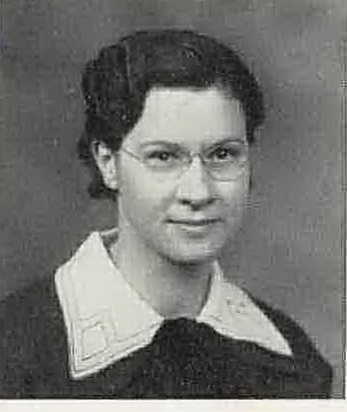
Staff Sergeant Ruth E. Schuerman (Reiners) joined the Women’s Auxiliary Army Corps (WAAC) in November of 1942. She joined because she wanted to do her part; both of her brothers were already serving and her sister was starting nurses’ training. Being over 21, a requirement for joining, Schuerman Reiners was prepared to do her duty as her government saw fit. She was living in Springfield, Illinois, and had to go to Peoria to register. When accepted, Schuerman Reiners had to go to Chicago to be shipped to Fort Des Moines with the other WAAC recruits. There she remembers needing to get in and out of an old army truck and then walking and walking in her high-heeled shoes, then being shown into the old stables as the WAAC dormitory.1 After basic training, she was told she would study Cooking and Baking.2 Cooking was one of the things the WAAC was expected to do to free up men for active service.3
Once she completed the Cooking and Baking training, she was a dietician for a local hospital while still living at Fort Des Moines until she got her orders. After receiving her TEC 4 grade in February of 1943, Schuerman Reiners set out for her unknown destination – most troops were moved secretly, including the WAAC – on a train she thought must have sat in a railyard for years before being pressed into service.4 She ended up in charge of the six cooks, the baker, and the butcher of the mess for the WAAC at Camp Shanks: Last Stop USA for soldiers being sent to the European front. Over 1.5 million men and women went through Camp Shanks on their way to the war in Europe.
Not long after Sgt. Schuerman’s arrival at Camp Shanks, in May of 1943, she was invited to the alumni banquet at Cattawissa, Pennsylvania. If she cooked or was there with WAAC Sgt. Dorothy Billman is hard to say.5 Later that year, in July, the WAAC stopped being auxiliary and became an official part of the army known as the Women’s Army Corps (WAC). All the members of the WAAC were given an option; stay and take the official army oath, or return to civilian life. Most chose to remain and take the oath and Schuerman Reiners was among those to remain.6
By August 1943, she received promotion to Staff Sergeant.7 At Camp Shanks, she cooked three meals a day for the 250 WACs stationed there permanently. This necessitated working 12 hours a day, but Sgt. Schuerman was on call twenty-four hours a day; the WAC was also shipping their members overseas and sometimes this increased the number she cooked those three meals a day by 2,500 or 3,000.8 This meant that not only were her duties increased, she could be called out any time of day or night to feed new arrivals.9 During an interview in 2010, Schuerman Reiners remembered that lunch was the most difficult meal, as about half the women had just come from the gas chambers where they practiced gas mask drills and were all sweaty.10
The WAC ate the same food as the men at Camp Shanks, heavy foods with lots of meat and potatoes. Unfortunately, the women were doing mostly clerical jobs and couldn’t eat that much of the heavy food, so there were complaints about the amount of waste. Schuerman Reiners went to the major in charge of the mess and pointed out, “Women don’t eat like men!,” and asked if she could plan her own menus.11 She was granted permission and put a stop to the waste. She still had to make the same food as the men were eating for the women heading overseas who were undergoing rigorous physical training which doubled her workload, but she was well-liked because of it. In fact, her food was so well known that she had to allow the WAC to bring a male guest for Sunday lunch.12
Sgt. Schuerman remembered her time at Camp Shanks as very busy, but very satisfying. Always on the go, either on duty or having fun, was the way she lived at Camp Shanks. Being the last stop for men and women heading to Europe, it was important to keep up morale. While not encouraged to fraternize much, the WACs did have a ‘day room’ where they were allowed to entertain male visitors after supper.13 There was also a movie theater and an acting theater. Schuerman Reiners remembers lots of entertainment, including Hollywood stars. She recalled only Mickey Rooney, but Jimmy Durante, Frank Sinatra, Myrna Loy, and Helen Hays were among the Hollywood entertainers to perform at Camp Shanks.14,15 Joe Louis was there to put on exhibition matches.16 Camp Shanks also had its own baseball team, orchestra, and newspaper.17 They even had basketball; their men’s team played the Harlem Globetrotters and Sgt. Schuerman played for the women’s team against other WAC units in 1944.18
SSGT Schuerman remembered sadly that after D-Day, many who were sent to Europe returned injured, some of them badly. But she didn’t want to dwell on that. By November of 1945, Schuerman Reiners had amassed her points and was getting ready to leave the WAC. That was when Colonel Galloway asked if she would come with her to California in preparation to going over to the Pacific Theater and be in charge of her mess there. But Schuerman Reiners felt her time in the WAC was over, so she received her discharge papers.19
Ruth Schuerman Reiners was born to Theodore and Frieda Schuerman on February 24, 1919, in Decatur, Illinois. She grew up in Illinois and it was from Springfield that she went into the WAC. Once she was discharged, she went home to find things rather boring after the round of duties and entertainments of Camp Shanks.20
Soon, however, she chose to make use of the G.I. Bill and went to Brooks Photography School in Santa Barbara, California. She chose photography because her father owned a photography shop.21 After moving to Los Angeles to attend Ted Archer’s Photo Color School, Schuerman Reiners began working in a portrait studio. It was there she met her husband of fifty-one years, Arthur Dean Reiners. They raised three children, a daughter and two sons. After thirty years in California, they moved to Alamogordo, New Mexico. Schuerman Reiners was not only proud to serve, she was also very proud of having both her sons in the US Air Force.22 Ruth E. Schuerman Reiners died in Rio Rancho, New Mexico May 5, 2019, at the age of 100.