
Navajo Code Talker, PFC, Sammy Silversmith
Born: December 15, 1923
Died February 7, 2001
PFC Sammy Silversmith was a Navajo Code Talker with the 4th Division of the United States Marine Corps from April 1943 to November of 1945.1 He received his training at Camp Pendleton just as the 4th Division was being reactivated due to the need for Marines in the Pacific Theater. He also had four weeks of additional Field Signal Training to become a Navajo Code Talker. It was there that he would memorize the over 400 words used by the Code Talkers. “Memorizing the dictionary and all code words was required during training. […] When a Navajo code talker received a message, they heard a string of seemingly unrelated Navajo words. The code talker first had to translate each Navajo word into its English equivalent. Then he used only the first letter of the English equivalent in spelling an English word.”2 Once his training was completed, PFC Silversmith was sent overseas with the USMC 4th Division.
According to his service records, he spent one year, nine months, and twenty-five days overseas. Because the 4th left Camp Pendleton in February of 1944, it’s likely that he was involved in all the major 4th Division amphibious expeditions from 1944 to 1945:
- Occupation of Kwajalein and Majuro Atolls – 1-8 February 1944.
- Capture and occupation of Saipan – 15 June to 24 July 1944.
- Tinian capture and occupation – 24 July to 7 August 1944.
- Assault and occupation of Iwo Jima – 19 February to 16 March 1945.3
- The 4th Division won two Presidential Unit Citation Streamers with One Bronze Star, one for Saipan and Tinian, 1944, and the other for Iwo Jima, 1945. In addition, they won the Navy Unit Commendation Streamer for Iwo Jima, 1945.4
Being a Navajo Code Talker was a difficult duty. Aside from the difficulties in receiving communications and decoding them promptly while under fire, as mentioned in the quote above, all communications were to be destroyed as soon as they were translated for fear of them falling into enemy hands.5 But the Navajo Code Talkers were a benefit to the USMC in every way:
“The primary strengths of the code talkers were the amount of secrecy that they ensured and the versatility with which they could be used. When compared to other messengers, the Navajos provided a valuable line of communication by radio that was both secure and error-free. […] In addition to functioning as messengers who provided a secure means of communication, the Navajos proved at Iwo Jima and other battles to be excellent general-duty marines, useful in a variety of operations.”6
Despite the difficulties, PFC Silversmith exemplified the strengths of the Code Talkers and remembered his service during an interview in 1971. When asked if he or any of the other Navajo had trouble adjusting to the jungle after living in the desert, he said, they didn’t have any as they were used to making do with what they had wherever they were. He remembered the best thing about serving was all the people from so many places that he met, and that he hoped they learned a little about Native Americans by meeting him.7
Sammy Silversmith was born at Crownpoint, New Mexico on 15 December 1923, though he appears to have listed 1922 on his enlistment papers.8 He was doing clerical work in Durango, Colorado at the time of his enlistment.9 After the war, Silversmith was a teacher and translator at Intermountain Indian School.10,11 In 1954, Silversmith had some health problems and had major surgery.12 He may have moved to New Mexico shortly after this as he and his family are apparently living there in 1955.13 Silversmith likely took the job in the Accounting Department of the Bureau of Indian Affairs that he had in the 1970s.14 By the 1970s, however, it was his daughters who were making a splash in New Mexico. In 1971, his daughter, Claudine, was an Education Major at Highlands University.15 His daughter Anna was the first female electrician’s apprentice in Albuquerque.16
It was unfortunate that Silversmith passed away on the seventh day of February 2001, since he missed receiving the acknowledgment that was his due with the awarding of the Congressional Silver Medal to the Code Talkers in July. “The unique achievements of the Navajo Code Talkers constitute a proud chapter in the history of the United States Marine Corps. Their patriotism, resourcefulness, and courage have earned them the gratitude of all Americans.”17
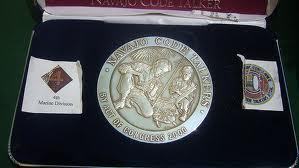
“Sammy Silversmith, Navajo Code Talker Medals.” Geni 26 April 2022. Retrieved: 3 July 2023.
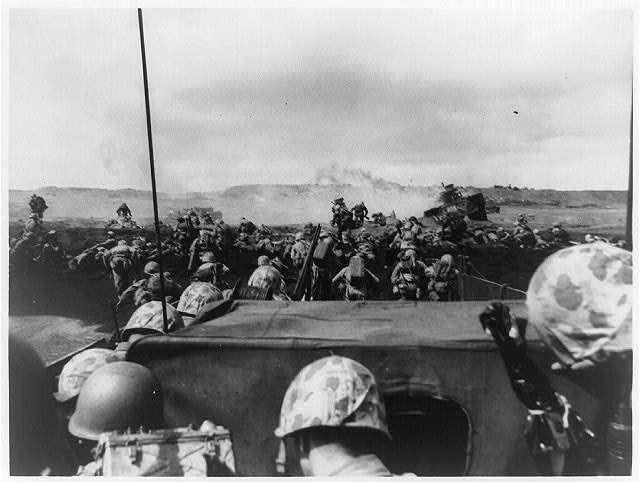
“A wave of charging Fourth Division Marines begin an attack from the beach at Iwo Jima, on D-Day as another boatload of battle-tested veterans is disgorged on the beach by an invasion craft.” Official Photographs of the USMC. 19 February 1945. Found at: Library of Congress. LOT 8754 [P&P;]. Digital ID number: cph 3b38740
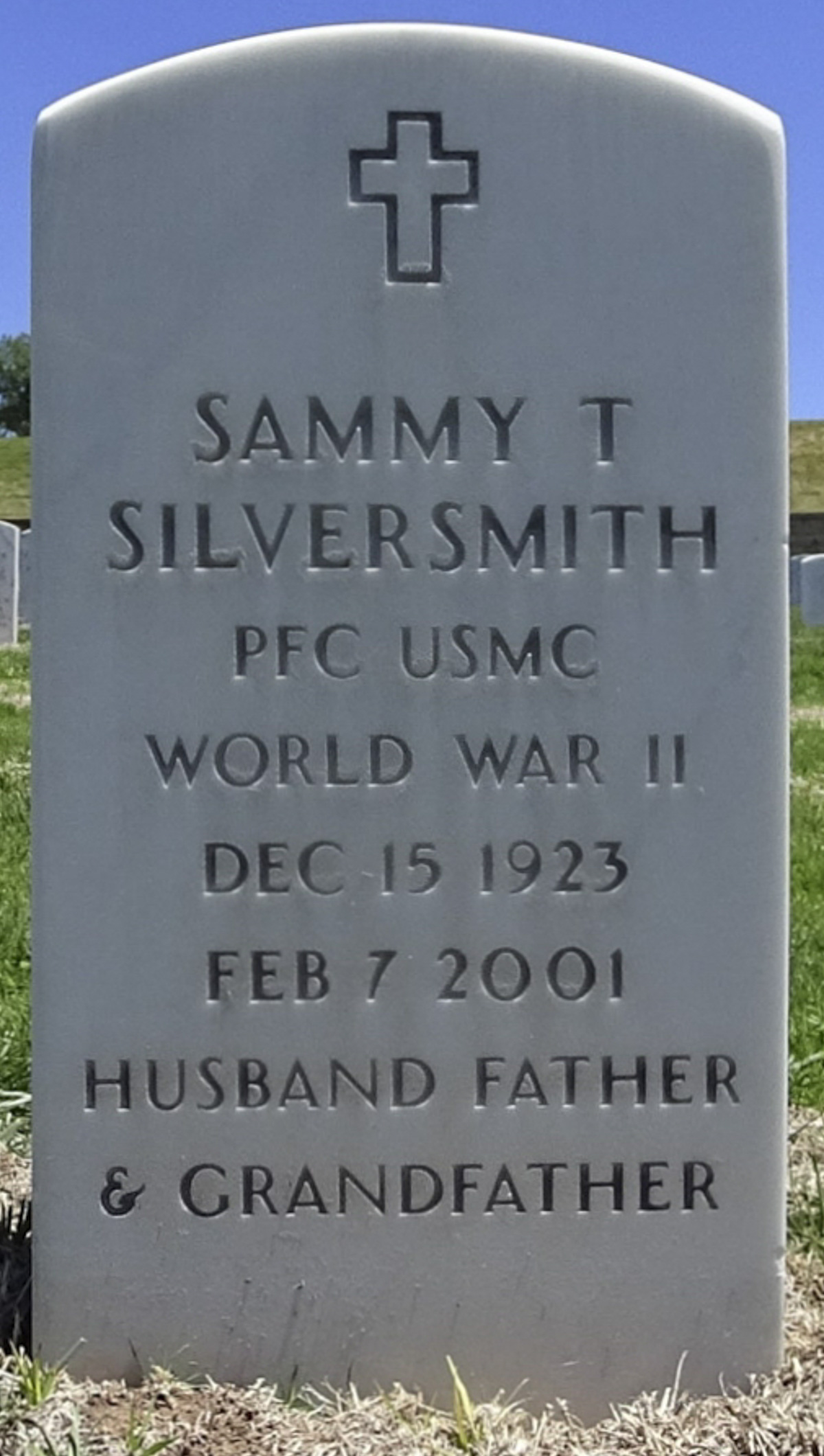
“Sammy Silversmith gravestone.” US Department of Veteran Affairs: Veterans Legacy Memorial. Copyright 2023. Retrieved: 5 July 2023. https://www.vlm.cem.va.gov/SAMMYTSILVERSMITH/876E21B
Notes:
- “Sammy Silversmith.” New Mexico Council of Defense. WWII Records Library, Series 18.3. New Mexico Adjutant General Records, Collection 1973–019, New Mexico State Records Center and Archives, Santa Fe, New Mexico.
- Fleischman, Patrick M., Lance Corporal. “Remembering the Navajo Code Talkers.” The Official Website of the United States Marine Corps. 14 August 2006. experts from para. 5 & 6.
- “Battle Honors of the Six US Marine Divisions in WWII.” USMC History: Branch Division. December 2001. 4th Division listing.
- Chapin, John C. First Lieutenant. The 4th Marine Division in World War II. 1974 Reprint. frontmatter, no page number.
- Fonesca, Felicia. “Navajo: Code Talkers Mission Critical to Outcome of World War II.” Santa Fe New Mexican. 30 August 2010. Sec. A p. 6.
- Jevec, Adam. “Semper Fideles, Code Talkers.” Prologue Magazine. Winter 2001, Vol. 33, No. 4. Found at National Archives: Publications. para. 22.
- Paul, Doris. “Interviews with Raymond Nakai and Sam Silversmith” University Archives & Historical Collections, Michigan State University. Audio Tape, 1971. Copyright Michigan State University.
8 & 9. “Sammy Silversmith, enlistment.” National Archives at St. Louis; St. Louis, Missouri; WWII Draft Registration Cards For Colorado.
- “Sammy Silversmith.” Department of Commerce. Bureau of the Census.
- “Yazzie Yarns.” Box Elder Journal. Brigham City, Utah. 1 August 1951.
- “Hospital Notes.” Box Elder Journal. Brigham City, Utah. 21 April. 1954. p. 7.
- “Mr. & Mrs. Silversmith.” Albuquerque Journal: Births. Albuquerque, New Mexico. 23 August 1955. p. 15.
- “Young Indian Makes Sparks Fly in Field Dominated by Males.” Albuquerque Tribune. Albuquerque, New Mexico. 31 May 1976. sec. B p. 1.
- “Claudine Silversmith.” Santa Fe New Mexican. Santa Fe, New Mexico. 4 May 1971. sec. A p. 7.
- “Young Indian Makes Sparks Fly in Field Dominated by Males.” Albuquerque Tribune. Albuquerque, New Mexico. 31 May 1976. sec. B p. 1.
- “Navajo Code Talkers in World War II.” Marine University: USMC History Division. June 2006. para. 7
Compiled by: A. D. McLean, MA, MLIS. Central New Mexico Community College, retired 2022.